Fluted Glass Kitchens: A Complete Guide to the Trend
Texture is quietly taking over kitchen design. After years of flat fronts and high-gloss everything, the rooms catching the eye now are the ones with something to touch, and fluted glass is leading that shift. Those soft vertical ridges, lit from within or simply catching the morning light, add a sense of depth and craft that a plain cabinet door can’t match.
This guide covers everything worth knowing about fluted glass in the kitchen: what it actually is, where to use it, how to style it, what it costs to keep looking its best, and how to make sure it still feels right in years to come. If you’re weighing up whether to bring it into your own kitchen, you’ll come away knowing exactly where it belongs and where it doesn’t.
Key takeaways
- Fluted and reeded glass are among the defining kitchen finishes of 2026, adding subtle texture, gentle light diffusion and discreet storage in a single detail.
- It works in both modern and classic schemes and looks especially good against natural timber and richer paint colours like deep green, taupe or charcoal.
- It’s ideal for wall units and pantry doors, where it hides everyday clutter while still letting light flow through.
- Used sparingly, one run of cabinets, an island end or a drinks cabinet – it delivers high impact without overwhelming a room or dating quickly.
- The simplest, most affordable way in is a glass-fronted wall unit worked into your existing layout.
What is fluted glass?
Fluted glass is textured glass moulded with a series of evenly spaced vertical grooves. The ridges distort light and blur whatever sits behind the pane, so you get the brightness and openness of glass without putting your shelves fully on display. The technique has roots in early 20th-century decorative arts; think Art Deco and mid-century interiors, which is part of why it reads as timeless rather than throwaway.
You’ll often see the terms ‘fluted’, ‘reeded’ and ‘ribbed’ glass used as if they mean the same thing. Strictly speaking, ‘fluted’ refers to concave grooves carved into the surface, while ‘reeded’ refers to convex ridges that stand proud — but in kitchen design, the two are used almost interchangeably, and both deliver the same softly striped, light-diffusing effect. For practical purposes, if you like the look, the label matters far less than the finish and the frame around it.
The glass itself comes in a few finishes, each suiting a different mood:
- Clear reeded glass — maximum light transmission; suits minimalist, Scandinavian and pale schemes.
- Bronze-tinted glass — adds warmth and pairs beautifully with brass hardware and darker cabinetry.
- Grey or smoked glass — softens contrast for moodier, contemporary palettes.
The key thing to understand is that fluted glass is translucent, not transparent. It lets light flow through while obscuring detail, which is precisely what makes it so useful in a working kitchen.
Why fluted glass is having a moment
Trends usually take hold because they solve a real problem, and fluted glass solves several at once.
It breaks up solid cabinetry. A long run of identical doors can feel heavy, almost wall-like. Dropping in a glass-fronted unit or two interrupts that mass and gives the eye somewhere to rest, instantly making a kitchen feel more considered.
It balances openness with privacy. Open shelving looks wonderful in photos and rather less wonderful in real life, where it demands constant tidying and colour-coordinating. Clear glass has the same problem. Fluted glass gives you the airy, light feel of glazing while gently hiding the mismatched mugs and the half-empty packets behind it.
It adds texture and warmth. As kitchens move away from cold, flat minimalism, designers are reaching for materials with tactility – boucle, timber, and fluted detailing. Glass ridges catch and scatter light differently through the day, so the surface never looks static.
It works across styles. Pair it with a sleek, handleless run, and it reads contemporary. Set it against painted timber and it adds a soft, almost period-glasshouse charm. Few materials are this flexible.
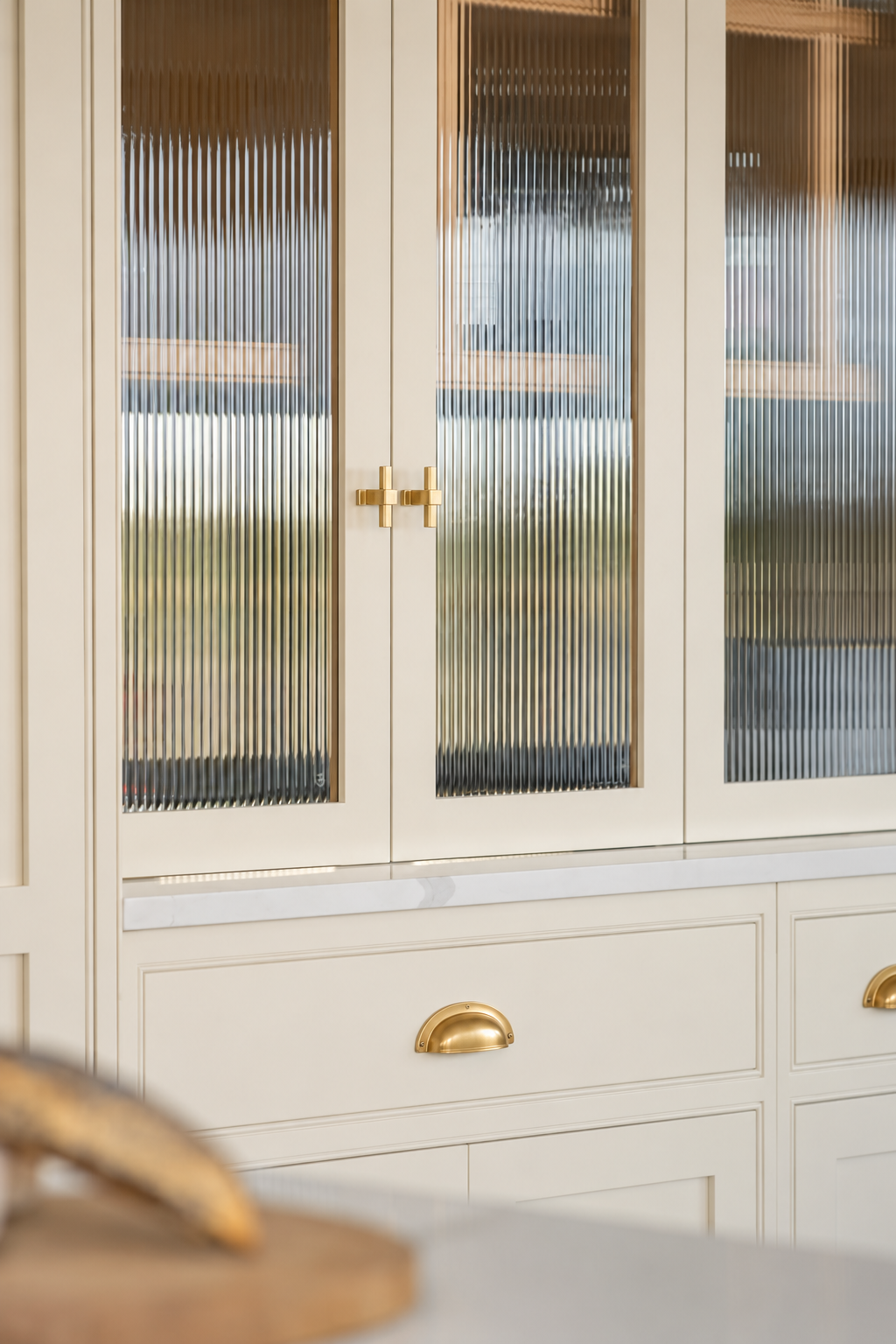
Design ideas: how to use fluted glass in your kitchen
This is the heart of the guide. Below are practical ways to introduce fluted glass. From a single feature cupboard to a full scheme, with guidance on when to keep things subtle and when to go bold.
Wall units and tall cabinets
This is the most common and most effective use. Reeded glass on the upper half of a kitchen lightens dense runs of cabinetry and brightens dark corners where natural light struggles to reach, which is particularly valuable in smaller kitchens. Tall larder and pantry doors become a quiet focal point, hinting at the glassware and ceramics inside without showing full detail.
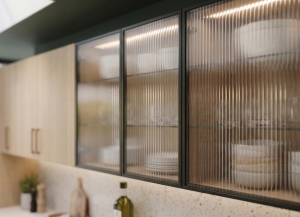
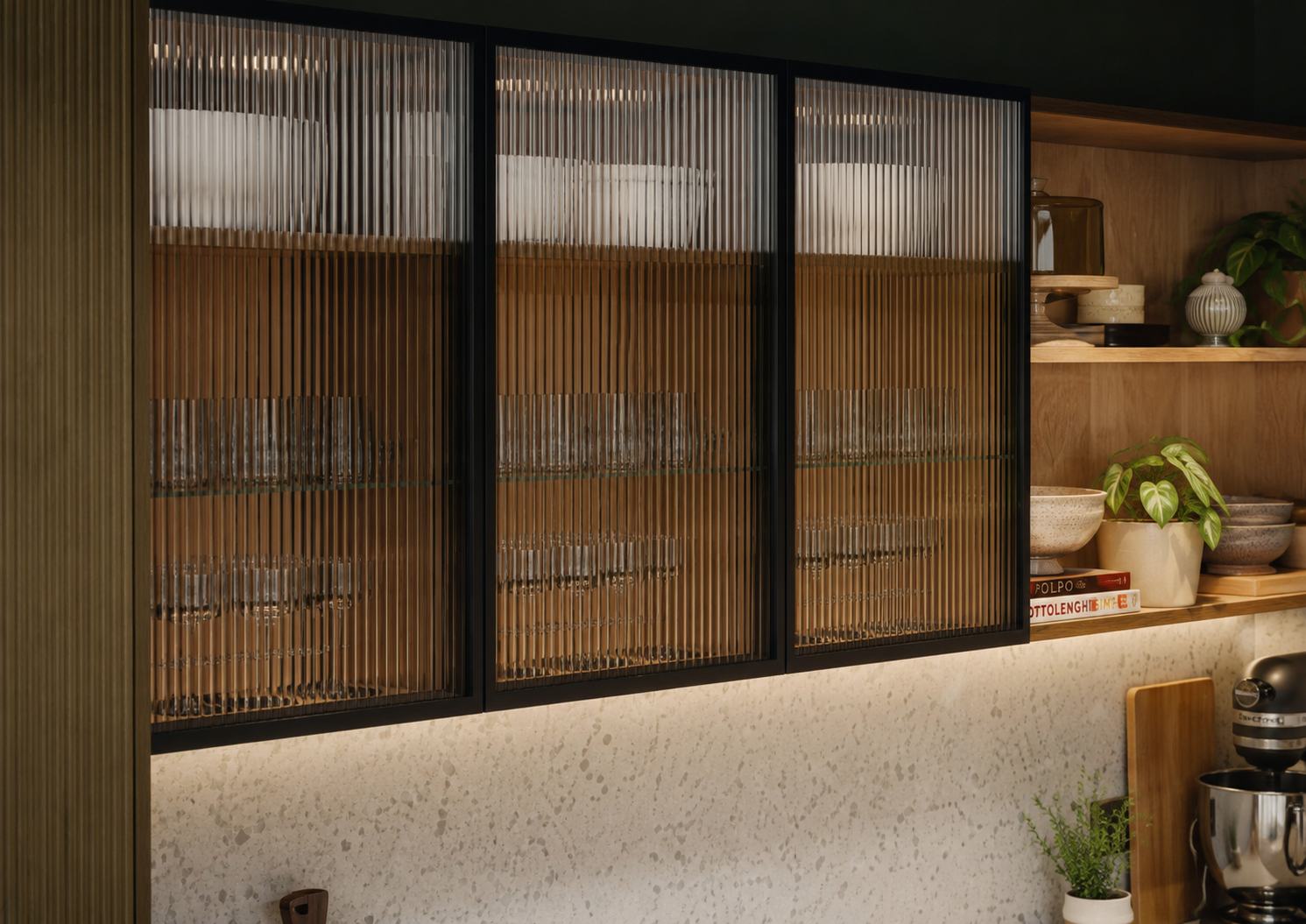
This is exactly where our aluminium-framed fluted glass wall units come into their own: they’re designed to slot into any of our ranges and lift an ordinary run of cabinets into something with real presence. A few tips for getting the most from them:
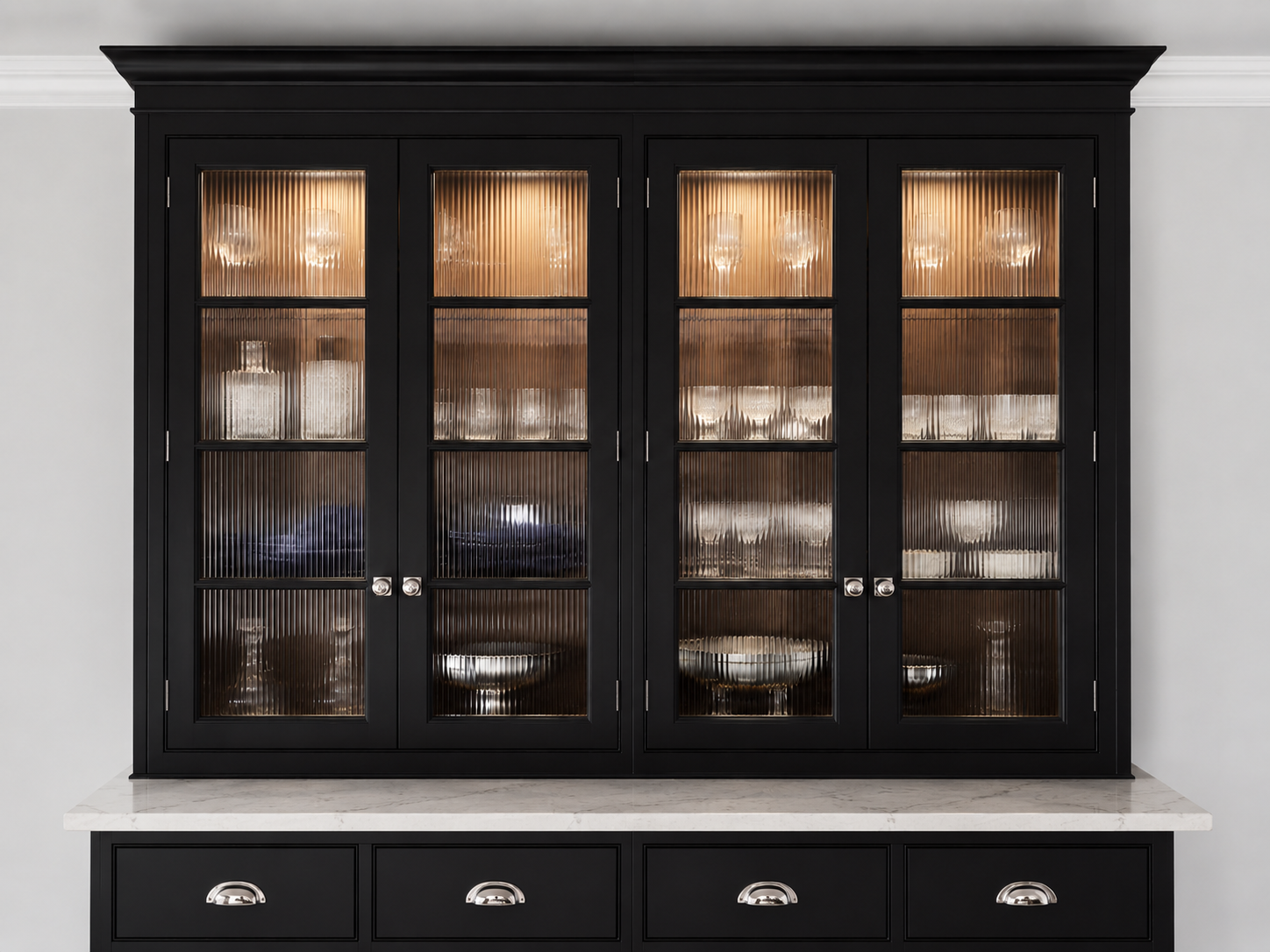
- Light them from within. An LED strip inside a fluted unit turns the ridges into a soft, hotel-bar glow after dark and makes the texture the hero of the room in the evening.
- Keep fronts away from the hob. Position glazed units away from the main cooking zone to minimise grease settling in the grooves.
- Mind the frame. Slim metal frames read sharp and contemporary; painted timber frames suit classic shaker or in-frame schemes.
Kitchen islands and peninsulas
A fluted panel on the end of an island or peninsula creates a textured focal point that anchors an open-plan room. Pair fluted detailing on the island base with smoother surrounding units so it adds warmth without overwhelming the space. Wider fluting reads architectural and modern; softly scalloped panels feel gentler and more decorative. As a rough guide, islands from around 2.2m upwards carry a full fluted treatment comfortably, smaller ones are better with a single feature panel.
Room dividers, screens and pocket doors
Beyond cabinetry, full-height fluted glass screens can separate a kitchen from a utility or dining area while preserving borrowed light — invaluable in compact, open-plan homes. Sliding or pocket doors in reeded glass tuck a breakfast cabinet or drinks station out of sight when it isn’t in use. As a bonus, fluted glass diffuses sound slightly, helping a kitchen-adjacent workspace feel a touch more separate.
Drinks cabinets, dressers and display units
A dedicated drinks cabinet or coffee station behind fluted glass gives you a stylish hint of glassware and bottles without the dust of fully open shelving. This is a lovely place to be playful with colour: paint the cabinet interior a rich shade — burgundy, teal or ochre, so the hue glows softly through the flutes. Echoing the detail elsewhere, in a ribbed pendant shade or a fluted vase, ties the whole scheme together.
A good rule of thumb across all of these: use fluted glass as punctuation, not as the whole sentence. One to three glazed features in a typical kitchen looks far more deliberate than a wall of them.

Why the aluminium frame makes the difference
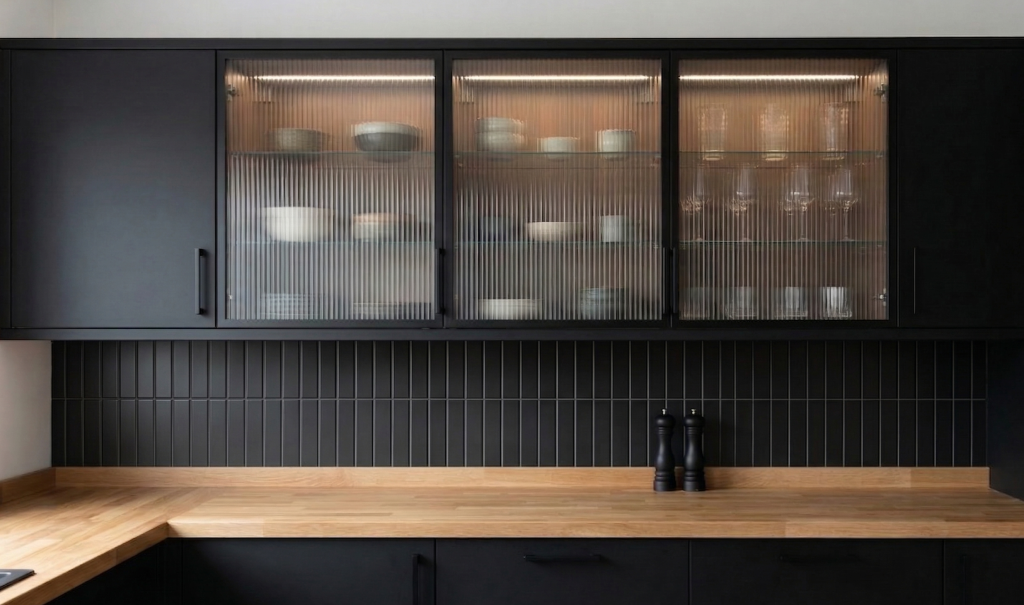
Fluted glass on its own is just a material — what turns it into a design feature is how it’s framed. Our aluminium frame fluted glass wall units pair textured fluted glass panels with a slim black aluminium frame, and that thin dark border is what gives the look its modern, gallery-like crispness. It defines the edge of each panel, frames the texture, and provides a clean contrast against painted or timber cabinetry.
It’s a genuinely versatile unit rather than a one-trick feature piece:
- Three heights to suit your layout: low (575mm), standard (720mm) and tall (900mm), all at a 350mm depth.
- Eight carcass colours so the cabinet body coordinates with your scheme: Davenport, White, Cashmere, Light Grey, Dust Grey, Graphite, Bardolino Oak and Lincoln Walnut.
- Everything included: each unit comes with the carcass and fluted glass frontage, plus free brushed steel T-bar handles, free soft-closing hinges and free height-adjustable legs. The handle holes aren’t pre-drilled, so you’re free to fit different handles if you prefer.
Prices start from £297.93, which keeps a design-led detail well within reach, particularly at the trade prices we supply direct. The fluted glass softly obscures whatever’s inside while still letting light through, so the units stay practical for everyday storage as well as for displaying glassware and the odd nice piece.
How to style fluted glass so it looks designed
Pair it with the right cabinetry
Fluted glass plays beautifully against both flat-fronted modern doors and framed, painted styles. The contrast between a textured glass panel and a smooth painted door is part of the appeal.
It sits especially well alongside slimmer shaker profiles, including micro shaker styles like our Regent range, where the refined frame echoes the crisp lines of the aluminium glass units. (We’ll cover the microshaker properly in a dedicated guide soon. For now, just know the two are a natural match).
Layer it with fluted wood and other textures
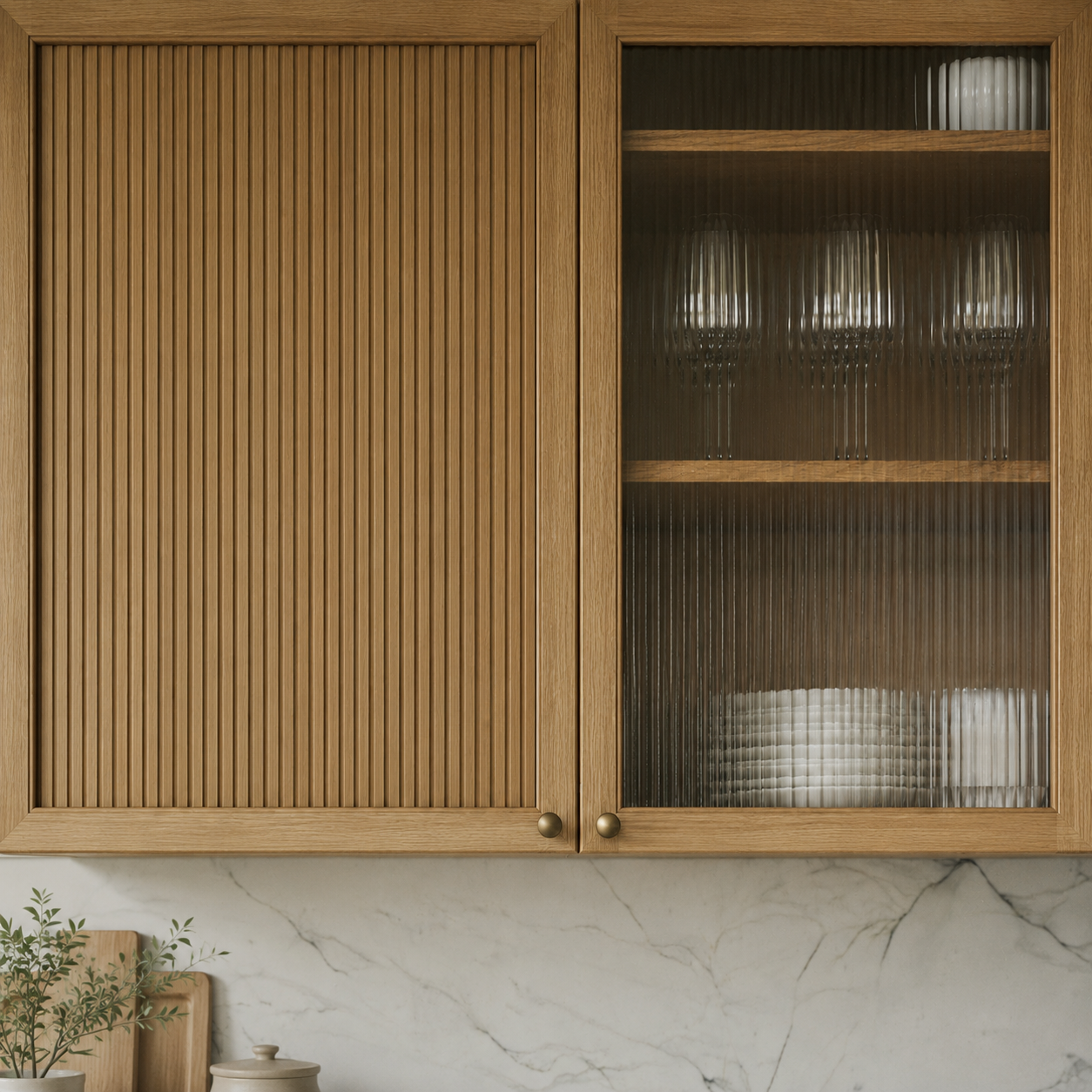
The most successful fluted kitchens layer textures rather than repeating one. Fluted wood on a base unit or island, balanced by fluted glass on the wall units, smooth painted doors elsewhere, a stone worktop and a metal accent or two — that mix creates depth without visual noise. The one rule worth holding to: choose a single dominant fluted texture and let everything else stay calm around it.
Get the colour palette right
A few combinations reliably flatter fluted detailing:
- Deep forest green with antique brass — classic, rich, characterful.
- Warm greige with natural oak — soft, organic, easy to live with.
- Charcoal with smoked glass — moody and contemporary.
Darker cabinet colours make the vertical lines pop through shadow play, while lighter palettes lean coastal or Scandinavian. And because vertical fluting draws the eye upward, it can visually stretch a room with a lower ceiling — pair it with light walls to enhance that effect.
Curate what’s behind the glass
Even though fluted glass blurs the detail, what you store still reads as colour and shape. Glassware, ceramics and a few well-spaced pieces look far better than a cabinet crammed to the edges. Treat the interior as part of the design.
Planning a fluted glass kitchen: practical considerations
Beyond looks, a few practical points are worth thinking through before you commit.
Place it where it’s seen. Position fluted features so they’re visible from the key viewpoints – the hallway, the dining table, and the sofa to get the most design impact for the least outlay.
Match the contents to the front. Reserve glass-fronted units for attractive glassware and crockery, and keep solid doors for the bulkier, less tidy items.
Specify toughened glass where it matters. For any large screen, partition or low-level door near busy walkways or where children are present, always use toughened safety glass. Standard wall-height units sit well above the bump zone, so this is far less of a concern there.
Mind the budget (in a good way). Because you only need a unit or two to make the statement, fluted glass is one of the more affordable ways to add a designer touch. It’s a far smaller commitment than re-doing every door.
Maintenance, cleaning and durability
Fluted surfaces need a little more attention than flat ones, because dust and grease can settle in the grooves. A microfibre cloth and a mild glass cleaner, wiped along the direction of the ridges, keep everything looking sharp — it’s hardly demanding, but it’s worth knowing.
Helpfully, the vertical texture actually hides fingerprints and watermarks better than smooth, high-gloss surfaces, so day to day it can look cleaner for longer. Keep heavily fluted fronts away from the main hob to reduce how often you need to wipe them down. And because glass doors put a little more stress on their fittings, good-quality soft-close hinges matter; they stop any rattle and protect the panel over time, which is why ours come with soft-closing hinges as standard.
Who does a fluted glass kitchen suit?
Fluted glass isn’t reserved for show homes; planned with care, it suits busy families, keen cooks and entertainers alike. Contemporary apartments tend to favour slim-framed reeded glass with handleless cabinets, while period homes lean into framed timber doors with gently fluted panels for a more timeless feel. Anyone who collects glassware or ceramics will love the soft display it allows.
And if you prefer hidden storage, the trend still works for you; used sparingly, a single drinks cabinet or island end brings it into almost any kitchen without a full redesign. One well-placed feature run is often all it takes to become the defining detail of the whole scheme.
Frequently asked questions
Can I add fluted glass to my existing kitchen? Often, yes. If your carcasses are sound and a standard size, you can refresh a tired run by swapping in glass-fronted units rather than replacing the whole kitchen. Updating a single run of wall units or adding one dresser-style feature can transform a kitchen that’s five to ten years old.
Does fluted glass make a small kitchen look bigger or smaller? Usually bigger. It reflects and diffuses light and breaks up solid cabinet runs while still hiding clutter. In very small rooms, choose lighter carcass colours and slim frames, and focus the fluting on upper wall units — the vertical ribs draw the eye upward, which helps rooms with lower ceilings feel taller.
Is fluted glass safe in a busy family kitchen? With toughened safety glass, fluted features are well suited to family homes. Keep tall glazed partitions away from high-impact play areas and use solid fronts at low levels where small children might bump into them. Wall-height glass units sit above that zone, so they’re rarely an issue.
Will the fluted glass trend date quickly? It’s less likely to than most. Although it’s surged in popularity in recent years, its Art Deco and mid-century roots give it a timeless quality. If you’re cautious, keep it to focused areas – a pantry door, a dresser or an island end – so it’s easy to update later, and lean on neutral colours and classic proportions to help it age gracefully.
How do I match fluted glass with my appliances and hardware? Because its texture is subtle rather than shiny, fluted glass pairs happily with stainless steel, black or panel-ready appliances. Coordinate the metalwork – brushed brass handles with a warm scheme or black-framed units with black ovens and taps – and keep at least one element, either the hardware or the worktop, smooth and simple so the overall look doesn’t feel overcomplicated.