Flat Pack vs Rigid Kitchen Units: What’s the Actual Difference?
If you’ve been pricing up a new kitchen, you’ll have come across the words “flat pack” and “rigid” more than once. If you’re anything like most of the people who ring us at the showroom, you’ll have a rough idea of what they mean but not much beyond that.
Is a rigid kitchen better built? Is flat pack the budget option? Does it matter if you’re fitting it yourself?
The honest answer is that the difference is smaller than a lot of kitchen retailers would have you believe, but it’s not nothing. So let’s clear it up properly, because it’s a decision worth getting right before you place an order.
First, what is a kitchen carcass?
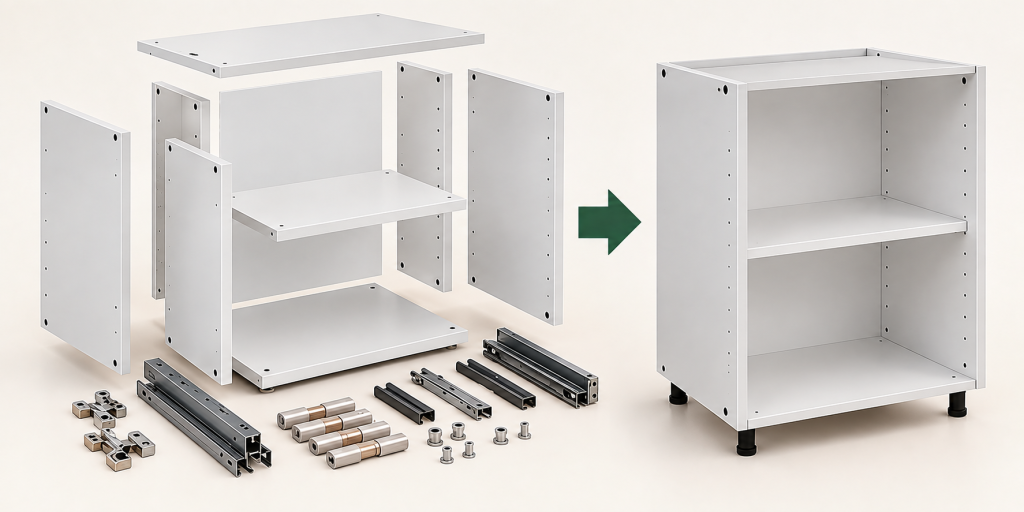
Every kitchen unit is made up of two parts. There’s the door (or drawer front) that you see, and there’s the box behind it that does all the work. That box is the carcass. It’s the base, the two sides, the back panel and the top rails or top panel, plus any shelves inside. The doors get all the attention, but the carcass is what holds up your worktop, carries the weight of your crockery and takes the knocks for the next twenty years.
Flat pack and rigid are simply two ways of getting that carcass from our workshop to your kitchen wall.
Flat-pack kitchen units explained
A flat pack unit arrives as a set of individual panels, packed flat in a box, along with all the fixings, hinges, legs, shelf supports and drawer runners you need to build it. You (or your fitter) assemble it on site.
The idea sometimes gets a bad name, and we’ll happily admit that there is some poor-quality flat-pack furniture out there. But the format itself isn’t the problem. Some very high-end German and Italian kitchens are delivered flat-packed – not because their makers are cutting corners, but because a flat box is easier to transport, easier to carry through a front door and around a tight staircase, and less likely to get damaged on the way.
At Kitchen Warehouse, every flat pack carcass we sell is made from 18mm Egger MFC board, which is a melamine-faced chipboard from one of the most respected board manufacturers in Europe. Base units have a full 18mm solid back panel rather than a thin hardboard sheet, so there’s nothing to flex or bow behind your worktop. Wall and tall units use a 12mm back.
Visible edges are lipped with 0.8mm ABS. Everything goes together with pre-inserted cams and dowels, and on most ranges the doors come pre-drilled for the hinges (on handleless ranges, where the handing can’t be known in advance, we send a simple hinge drilling kit instead). The hinges are Hettich Sensys soft-close, made in Germany, and drawer units come with Hettich Innotech Atira soft-close runners rated to 30kg.
Have a look at our Unit Specification page to get the full detail.
Rigid kitchen units explained
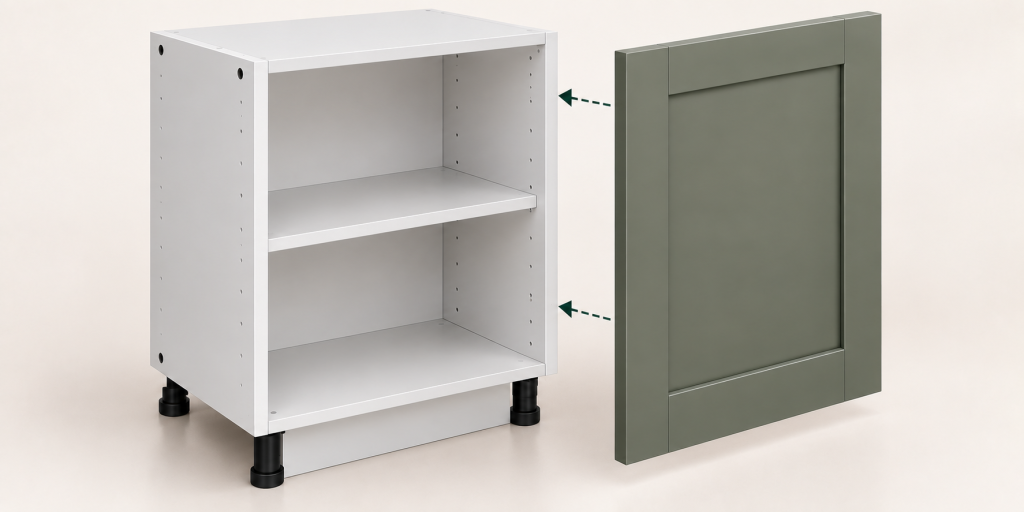
A rigid unit is the same carcass, but we build it for you before it leaves Ripon. Each cabinet is assembled in our workshop, the drawer boxes are fitted, any pull-out mechanisms such as magic corners or larder pull-outs are installed, and the doors and drawer fronts are hung and adjusted. Every unit is then individually checked, wrapped and palletised, so it arrives ready to fit – no assembly needed.
Rigid units are made from the same 18mm board as our flat pack units – though buyers benefit from thicker 18mm backs on the tall and wall units, as well as 2mm ABS edging.
These upgrades come as part of our Ashton Cole collection, which also gives you access to custom units, a vast range of carcass colours and the fancier accessories – all only available if you’re buying a rigid kitchen, as your kitchen is essentially being built custom for you in our warehouse. Other than that, though, the material is identical. You’re not paying for a stronger cabinet; you’re paying for us to build it, and to save yourself the time (and cost) of a joiner.
So which one is stronger?
Once it’s assembled and fixed to the wall, a well-built flat-pack unit and a rigid unit are the same cabinet. Same board, almost entirely the same thickness, same hinges, same runners. The strength of the finished kitchen depends far more on the quality of the board and the quality of the fitting than on who screwed the panels together.
Where rigid units have a small edge is consistency. Our workshop team builds cabinets every day, so every joint is square, every cam is tight and every door is adjusted before it goes out. A flat pack unit built carefully with a bit of patience will end up just as solid, but a flat pack unit built in a hurry on a Sunday afternoon might not. In other words, the strength difference isn’t in the product; it’s in the assembly.
What it means for a DIY fit
This is usually the real question behind “flat pack or rigid”, so let’s be direct about it.
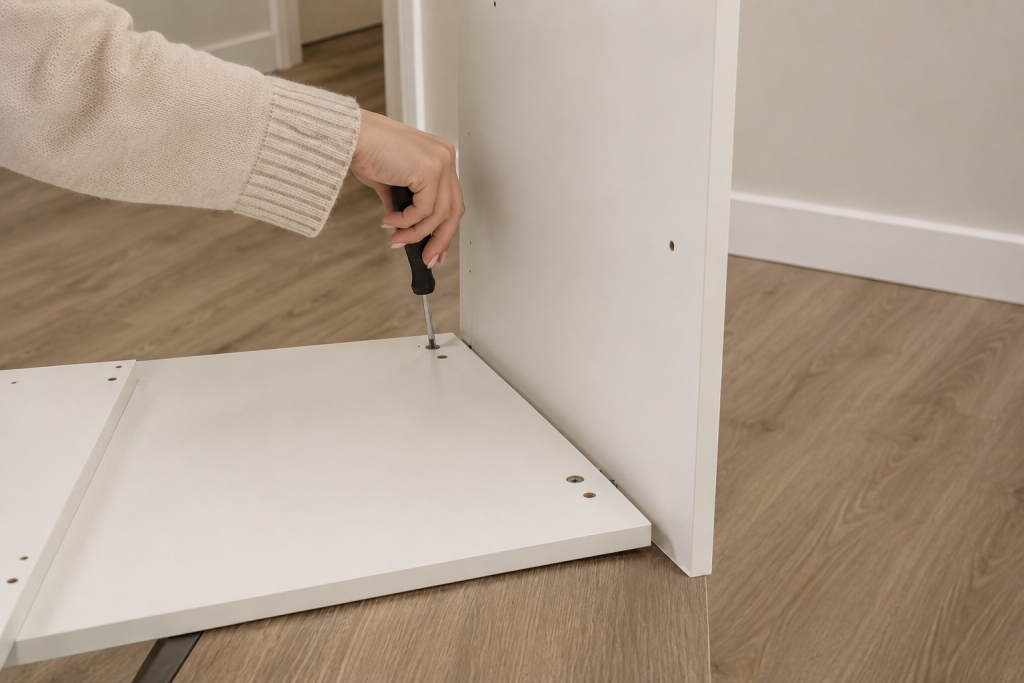
Most of our customers are perfectly capable of building our flat pack units. The instructions are clear, the parts are pre-cut and pre-drilled, and we’ve got how-to videos covering unit assembly, fitting corner base units, adjusting hinges and more. If you can put a bookcase together, you can build a kitchen cabinet.
Once you’ve got the hang of it, each unit doesn’t take long, though allow a bit longer for the first one or two, and you’ll want a clear floor space, a drill driver, a hammer and a decent Pozidrive bit.
The parts of a kitchen installation that catch people out are almost never the cabinet assembly. They’re scribing the end panels to a wall that isn’t straight, cutting worktops, and getting a long run of units perfectly level. Rigid units don’t allow you to skip those tasks. They save you the assembly time and take away the risk of a wonky build, but the fitting itself is exactly the same job.
If you’re paying a fitter, ask them which they’d prefer. Plenty of the kitchen fitters who buy from us actually like flat pack, because the boxes are easier to get into the property, and they can build the units in the room they’re going into rather than manoeuvring an assembled tall larder unit up a flight of stairs.
Cost, lead times and delivery
Flat-pack is cheaper, and there’s no mystery about why. It’s quicker for us to pick and pack, and it takes up far less room on a lorry.
Our rigid build service costs 10% more than the flat pack price, capped at £500 per kitchen, so if your order comes to more than £5,000, you won’t pay more than an extra £500. Lead times are roughly a week longer than the flat pack lead time shown on the website, because we’re physically building every cabinet.
Delivery is where the two really part ways. Flat-pack kitchens go out on a pallet with a courier and can reach anywhere in the UK mainland, with free delivery on orders over £1,000 (smaller orders carry a £90 charge).
Rigid kitchens go out on our own transport from our Ripon workshop (HG4 5LZ), which keeps them in perfect condition. Rigid delivery is priced by distance from Ripon, so the further you are from North Yorkshire, the more it adds up, and there’s a minimum order value for the service.
Full details are on our Shipping & Returns and Rigid Kitchen Information pages, and we’ll always quote the delivery cost before you commit. Rigid units are also heavy and awkward. Some can weigh over 60 kg; our drivers stay with the vehicle and aren’t insured to enter the property, so you’ll need at least two able-bodied people at the property to carry everything inside.
| Flat Pack | Rigid | |
| Carcass material | 18mm Egger MFC (12mm backs on tall and wall units) | 18mm Egger MDC |
| Assembly | On-site by you or fitters | Built, fitted, and checked in our workshop |
| Doors and drawers | Pre-drilled on most ranges, fitted on site | Hung and adjusted before delivery |
| Price | Standard website price | +10%, capped at £1,000 |
| Lead time | As shown on the website | Roughly one week longer |
| Delivery | Courier pallet, UK mainland; free over £1,000 | Our own transport, priced by distance from HG 5LZ |
| Best for | DIY fits, tight access, keeping costs down | Saving time on site, custom specifications & custom units, peace of mind, extra finishes & colours |
Which should you choose?
Go flat pack if you’re fitting the kitchen yourself or your fitter is happy to build it, if access to the room is tight, or if you’d rather put the savings towards a better worktop or a couple of extra drawer units. It’s what the vast majority of our customers choose, and it’s the same cabinet at the end of the day.
Go rigid if you’re local or within a sensible driving distance, if you want to shave a day or two off the fitting time, if you’d rather not think about assembly at all, or if you’re ordering through the showroom anyway and want us to talk through a tricky specification with you. It’s also a good shout if you’re paying a fitter by the day, since the time saved on assembly can offset the extra cost.
Whichever way you go, you’re getting the same 18mm board, the same German hardware and the same trade prices direct to the public. If you’re still not sure, our team has fitted, built and delivered plenty of both, so give us a call and we’ll talk it through with you honestly.
You can browse the full range of kitchen units online, read our Flat-Pack Kitchens Guide or find out more about our rigid build service.